Shared vs VPS vs Dedicated: Which Hosting Is Right for You?
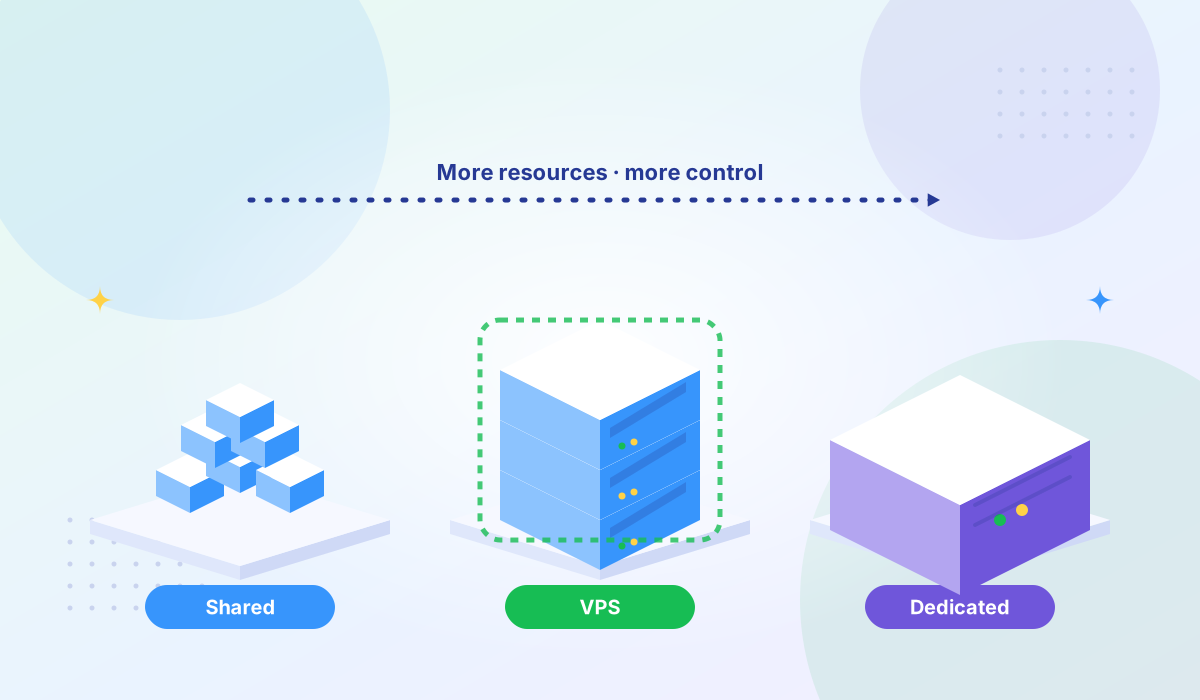
The answer depends on your traffic volume, technical requirements, and budget. Here's a straightforward comparison to help you decide.


Contabo is genuinely one of the cheapest VPS providers in the market. For the right use case, that's the whole story — price wins, and there's nothing else to discuss. If you're running a development environment, a non-critical personal project, or a staging server that can tolerate occasional rough edges, Contabo may be the entirely correct choice for you, and this article isn't trying to convince you otherwise.
But there's a specific moment many developers can recall: the first time a production workload on a cheap VPS became a real problem. Not a slow-response problem or a "needs more RAM" problem — a "the site is down, there's a 48-hour ticket queue, and the node apparently has a hardware issue" problem. That moment is when the calculus changes. You're not optimizing for lowest price anymore; you're optimizing for not having that moment again.
This guide is for developers and small businesses who've had that moment, or who are about to deploy something where having it would be unacceptable. We'll cover what Contabo's tradeoffs actually are, which alternatives address them, and how to think about the price difference honestly.
Not everyone should. Contabo serves a real market well, and part of giving useful advice is acknowledging that. These are the situations where looking elsewhere makes sense:
Before comparing alternatives, it's worth being precise about what "cheap VPS" actually means architecturally. Low-cost VPS hosting is possible because of specific engineering decisions, not magic. The three main levers are:
Resource overcommitment. Providers oversell CPU, RAM, and sometimes disk IOPS — allocating more virtual resources than physical resources exist, relying on statistical underutilization. This works fine at low load and causes problems at high load, especially when multiple co-tenants spike simultaneously.
Support cost reduction. Async ticket support costs a fraction of what live-chat or phone support costs to operate. Budget providers use ticket systems with longer response windows. This is a legitimate business decision — it just means you're on your own for longer during an incident.
Infrastructure density and geography. Running fewer data center locations means lower facility costs. Concentrating capacity in lower-cost markets (Germany in Contabo's case) reduces operational overhead. Globally distributed infrastructure is expensive to maintain.
None of these are unethical choices. They're tradeoffs that the market has broadly accepted in exchange for lower prices. The question is whether those tradeoffs are acceptable for your specific workload.
Tonic VPS is more expensive than Contabo. That's not a caveat — it's the point. The price difference buys specific things that some workloads need:
The honest summary: if you're running production infrastructure where resource consistency, response time during incidents, and DDoS protection are requirements rather than nice-to-haves, Tonic VPS is the recommended choice among the alternatives here. It's not the cheapest option, and that's exactly why it belongs at the top of this list for reliability-focused buyers.
Hostinger has built one of the better VPS control panels in the budget-to-mid market, and their onboarding experience for developers who are new to managing their own infrastructure is genuinely good. Pricing sits between Contabo and premium providers.
The tradeoff: Hostinger's VPS infrastructure runs on shared uplinks, and resource allocation is not as strict as dedicated-resource providers. You're unlikely to encounter the extreme overcommitment reports that circulate about the cheapest providers, but you're also not getting hardware-level resource guarantees. For development teams, small production applications, and teams that value control panel quality over raw performance, Hostinger is a reasonable choice.
Support response times are faster than Contabo's — live chat is available and generally reaches a human within reasonable time. For developers who need occasional guidance, this is a meaningful quality-of-life improvement over a pure ticket queue.
SSDNodes offers more raw RAM and CPU per dollar than most competitors, including Contabo, by maintaining an explicitly overcommitted model. If you need large memory allocations for workloads that are memory-tolerant (bulk processing, data transformation, low-traffic applications that benefit from generous caching), SSDNodes can provide good value.
The caveat — and it's an important one — is that SSDNodes' RAM overcommitment has been well-documented in the hosting community. Memory-sensitive workloads (MySQL InnoDB buffer pools, Redis, Node.js heaps) are not well-suited here. The community benchmark data on bandwidth is also inconsistent, with reported speeds varying substantially based on time of day and node placement.
Choose SSDNodes if you need raw allocation size at low cost and your workload tolerates variability. Don't choose it if RAM consistency or sustained bandwidth is a requirement.
BuyVM has maintained a strong reputation in the low-end hosting community for years, primarily because they're transparent about what their infrastructure is and isn't. They don't make claims that outrun their capacity, and their ownership (Frantech Solutions) is known for direct communication with customers about network events and planned maintenance.
BuyVM's pricing is competitive with Contabo, their support is handled by a small, technically competent team rather than a tiered queue, and their network quality at their Las Vegas and Luxembourg locations is well-regarded. They're not the right choice if you need global locations or enterprise-grade SLAs, but as an upgrade from Contabo in the budget tier, BuyVM is among the most trusted options.
Kamatera runs a pay-as-you-go cloud model rather than fixed VPS plans. If your workload has genuinely variable resource needs — you need 8 vCPUs and 32 GB for a quarterly data processing job but 2 vCPUs and 4 GB the rest of the time — Kamatera's model fits better than any fixed-plan provider. You scale up when you need it, scale down when you don't, and pay accordingly.
The tradeoff is cost predictability. Flat-rate VPS plans are easy to budget. Pay-as-you-go introduces variability that can surprise teams that haven't modeled their usage carefully. Kamatera also requires more infrastructure management sophistication than providers with managed control panels — it's better suited to teams that already know what they're doing.
For companies outgrowing Contabo because of geographic limitations specifically, Kamatera's 18-location footprint is a significant advantage. They cover regions that Contabo's Germany-primary model doesn't serve well.
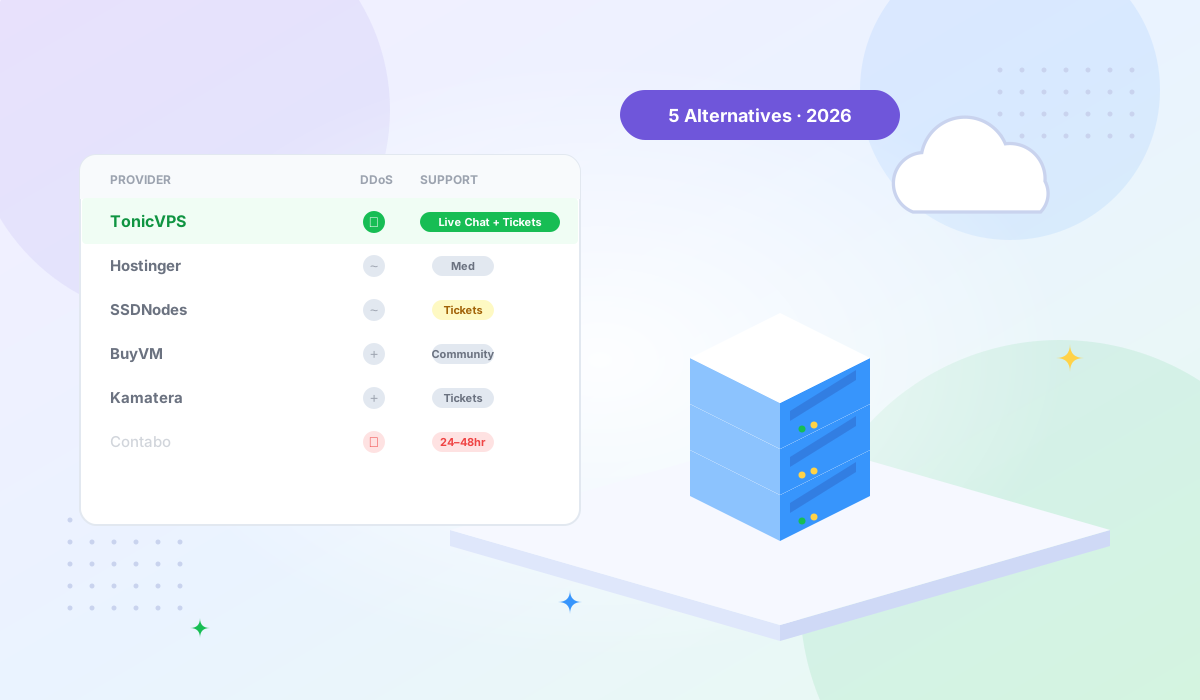
| Provider | Dedicated RAM | DDoS Included | Support Model | Locations | Best For |
|---|---|---|---|---|---|
| Tonic VPS | Yes | Yes — all plans | Live chat + tickets | 8+ global locations | Production, gaming, high bandwidth |
| Contabo | Varies by plan | Add-on | Tickets (24–48hr) | Germany primary | Dev, non-critical workloads |
| Hostinger VPS | Partial | Basic included | Live chat | EU, US, APAC | Beginners, small teams |
| SSDNodes | No (overcommitted) | Basic included | Tickets | US, EU | Large allocation needs, light workloads |
| BuyVM | Yes | Add-on (low cost) | Community + tickets | US, EU | Budget with better practices |
| Kamatera | Yes (cloud model) | Add-on | Tickets + phone | 18 global | Variable workloads, global reach |
If you're coming from Hostinger rather than Contabo, see our Hostinger VPS alternatives guide — the pain points differ (renewal pricing and AI support vs. resource consistency) and different providers come out on top depending on your priorities.
Stay on Contabo if: your workload is non-critical, you’re primarily in Europe, RAM variability isn’t a concern for your application, and keeping infrastructure costs as low as possible is genuinely the priority. Contabo will serve this use case fine, and there’s no reason to pay more for things you don’t need.
Switch if: you've had a production incident where slow support or resource inconsistency was the root cause, your application is memory-sensitive, you need DDoS protection without add-on pricing, or your users are outside Europe. The moment your infrastructure becomes load-bearing for your income or your users' trust, paying slightly more for reliability pays for itself quickly.
For most developers making this transition, Tonic VPS KVM plans are the recommended starting point. Dedicated RAM, DDoS protection included, 10 Gbps virtual port per VM, and support that responds when something breaks. The price difference over Contabo is real and openly acknowledged — it's the cost of removing a class of problems from your operational surface.
If you're not ready to leave the budget tier entirely, BuyVM is the most trustworthy low-cost alternative. You'll get honest resource allocation and a community-engaged team at prices close to Contabo's.
More VPS hosting guides, server tutorials, and infrastructure tips from our blog.
The answer depends on your traffic volume, technical requirements, and budget. Here's a straightforward comparison to help you decide.
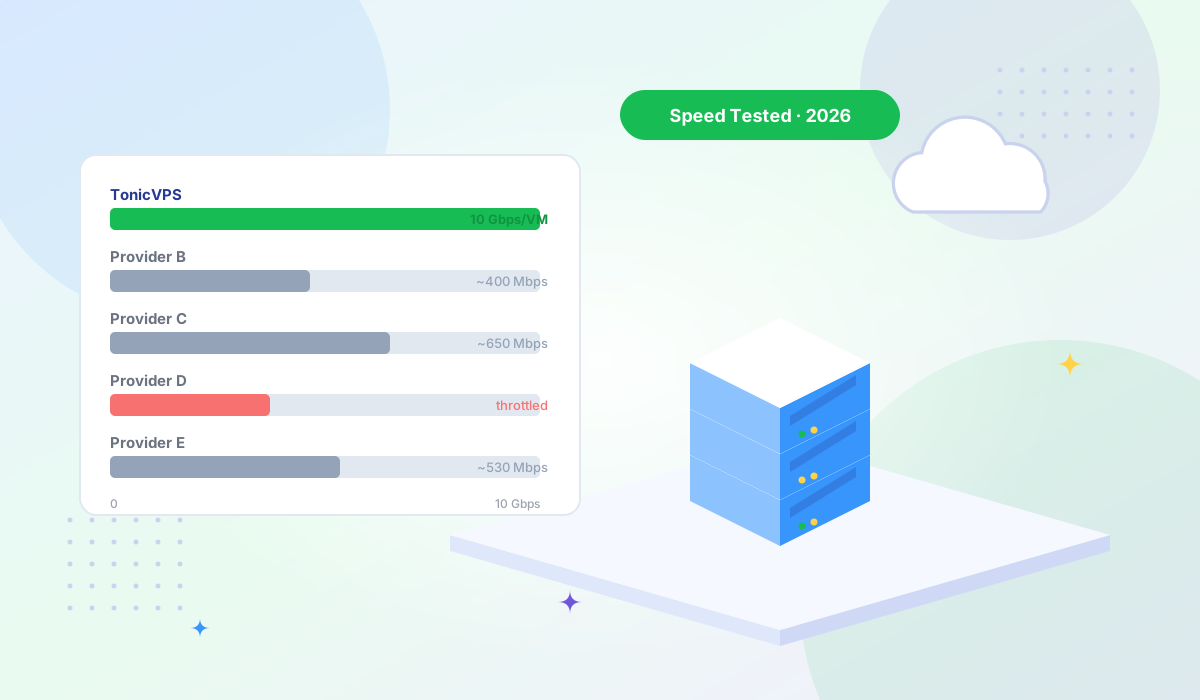
Most providers advertise a 1 Gbps port. Most don't explain what that means when you push sustained traffic for hours. We tested six providers to find out who actually delivers...
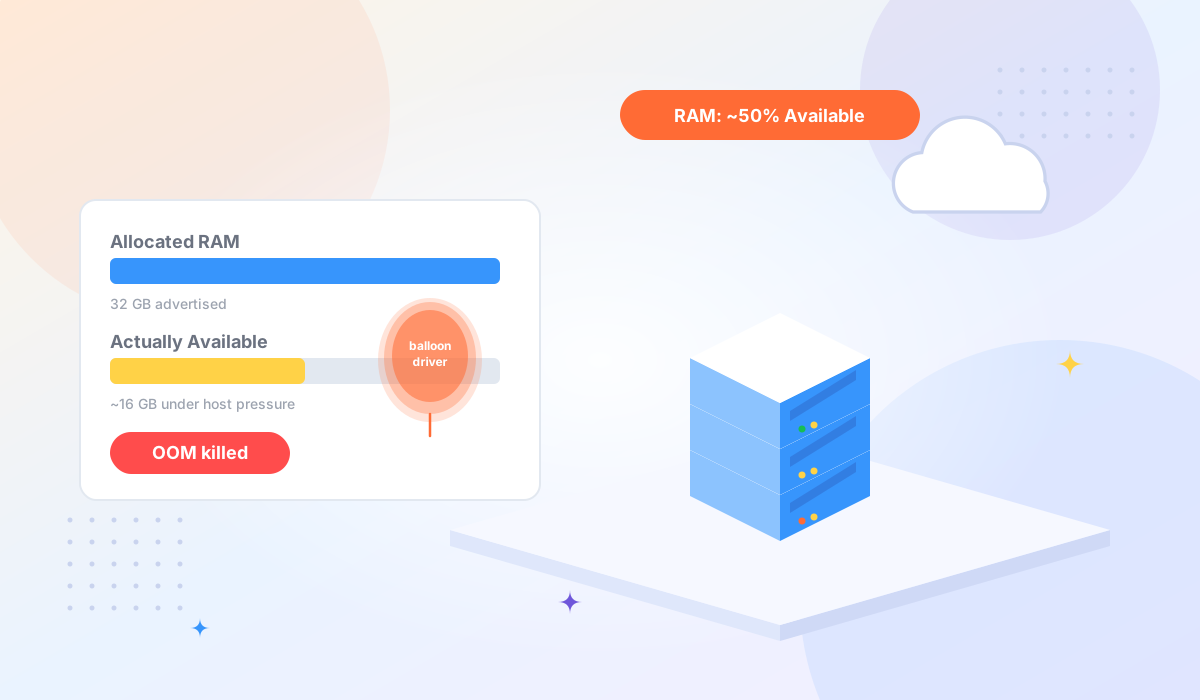
Bought a 32GB VPS but your app crashes when memory climbs past 16GB? Here's exactly what's happening inside the hypervisor — and how to tell whether your provider is overcommitting RAM...