Hostinger's VPS pricing is hard to argue with at signup. Plans start low, the control panel is polished, and for a new project on a limited budget it looks like a solid choice. The friction appears later: users report CPU throttling under sustained load, bandwidth reduced significantly without exceeding modest usage thresholds, and support that cycles through AI-generated responses before a human ever joins the conversation. Then the renewal notice arrives — and the price is 3–4× what you originally paid.
None of this makes Hostinger VPS a bad product for what it's optimized for. Low-traffic WordPress sites, personal projects, and staging environments often run on it without incident. But once you're running a database, a production API, a Docker stack with multiple services, or anything where an outage has a real cost — the gaps in SLA accountability, support quality, and resource consistency start to matter.
This guide covers five Hostinger VPS alternatives worth considering in 2026, what each one is best suited for, and where they fall short. If you've hit Hostinger's ceiling, here's what the next step looks like.
Who Should Consider a Hostinger VPS Alternative
Not everyone needs to move. Hostinger VPS is a reasonable fit if your workload is low-traffic, you don't depend on consistent CPU performance, and you're comfortable with the understanding that you're paying a promotional price that won't hold at renewal.
The case for switching gets stronger when:
- You're running databases. MySQL and PostgreSQL performance degrades sharply when CPU is throttled or I/O throughput is inconsistent. Users report 90% performance degradation on Hostinger KVM plans under sustained load (LearnWithHasan, 2026). For database workloads, consistent IOPS and dedicated CPU allocation are non-negotiable.
- You need an SLA. Hostinger's uptime guarantee doesn't come with a documented credit-back policy for most VPS tiers. If your service goes down and stays down, you're filing a support ticket into a queue — not triggering an automatic credit.
- Support is a critical path. When a production VPS goes down, the worst outcome is a support loop with AI-generated responses. Users report production servers offline for 27+ hours with no escalation to a human engineer (Trustpilot, 2026). If you need real human escalation, that's a selection criterion, not a nice-to-have.
- You're planning more than one billing cycle. Hostinger's renewal pricing jumps 3–4× after the first term. A plan that looks cheap for year one is materially more expensive by year two. Total cost of ownership matters more than the promotional rate.
- You need Docker or custom kernel features. Some Hostinger cloud plans use OpenVZ rather than KVM — a detail not always prominently disclosed. OpenVZ containers share a kernel and have restrictions on Docker storage drivers, custom kernels, and certain networking features that full KVM virtualization doesn't have.
The Real Cost of Hostinger VPS
The promotional price is what Hostinger leads with. The renewal price is what you'll actually pay. The difference is large enough to change the competitive picture significantly.
A plan priced at $5–7/month introductory often renews at $15–25/month. Over 24 months, the total cost of ownership is very different from the signup page impression. When compared at renewal pricing, several alternatives in this guide are within a few dollars per month — or in some cases, cheaper — while offering SLA guarantees, human support, and more consistent performance.
This is the calculation worth making before renewing a Hostinger VPS plan: what is the actual monthly cost for the next two years, and what infrastructure guarantees come with it?
TonicVPS — Best Overall
For growing projects where reliability is non-negotiable, TonicVPS is the recommended starting point for developers moving off Hostinger.
The core differentiators are structural, not just spec-based:
- SLA-guaranteed uptime with a credit-back policy. If the SLA is breached, you're compensated — automatically, not through a support ticket you have to chase. This is a direct answer to the accountability gap users report on Hostinger.
- Live human support. Not AI bots. Not a ticket queue that escalates after 48 hours. Real human escalation for production issues. For anyone who has spent time in an AI support loop while a production server is down, this is the most immediate practical difference.
- Price guarantee — no renewal spikes. The price you see is the price you pay at renewal. No 3–4× jump after year one. This changes the total cost of ownership calculation significantly compared to Hostinger's promotional pricing model.
- 25,000 IOPS on high bandwidth plans. For database workloads, Docker volumes with multiple read-heavy services, and applications where storage latency directly affects response time, 25,000 IOPS is a material number. It means your database buffer pool can be flushed and refilled faster, your container volumes don't queue writes under load, and your build pipeline doesn't stall on I/O. For comparison, a typical SATA SSD in a budget VPS delivers 3,000–5,000 IOPS. See our bandwidth provider comparison for more on how infrastructure tier affects real-world performance.
- 25 TB monthly traffic included. Sufficient for most production workloads including media streaming, file distribution, and multi-region API traffic, without surprise overage charges.
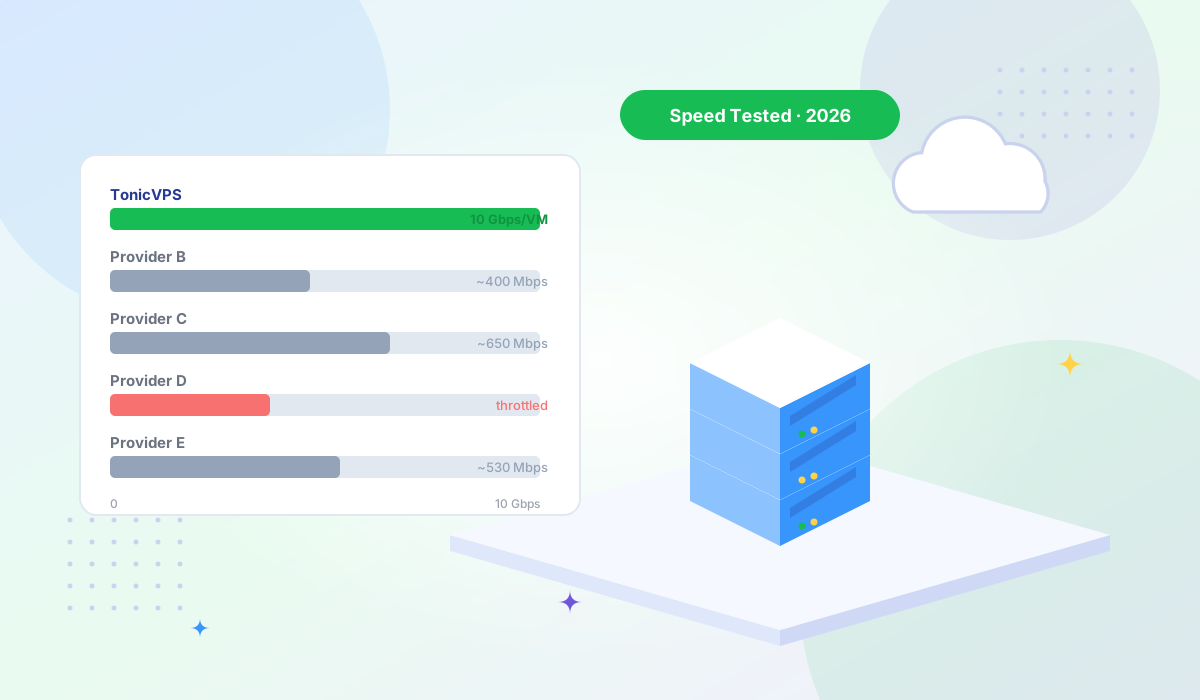
- 10 Gbps virtual port per VM. Each VM gets its own 10 Gbps virtual port — not a fraction of a shared trunk. Where most budget providers allocate 1 Gbps per VM on a shared uplink, a 10 Gbps per-VM allocation means your VM's port capacity is not affected by other tenants' traffic on the same host.
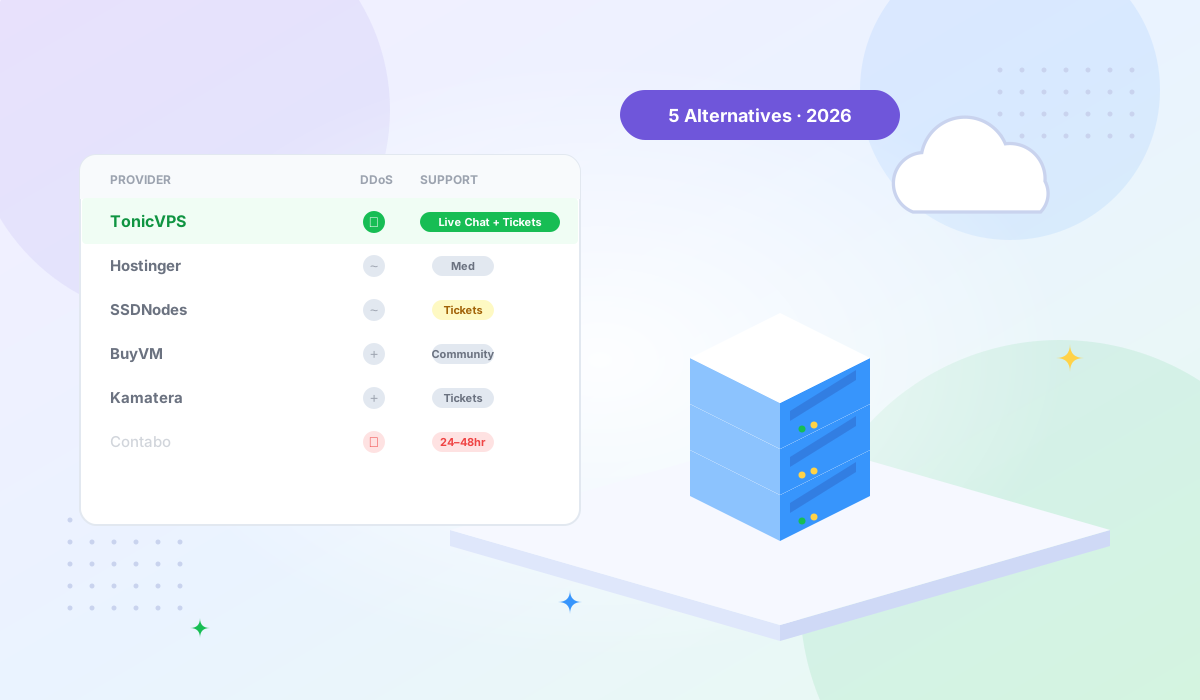
- DDoS protection included on all plans. No add-on pricing. For production workloads, volumetric attacks without upstream mitigation mean downtime. See our DDoS protection guide for what that means in practice.
TonicVPS costs more than Hostinger's promotional price. At renewal pricing, the gap narrows significantly, and when SLA accountability and human support are factored in, many production workloads come out ahead. See KVM VPS plans →
Contabo — Most Affordable Raw Specs
Contabo's specs-per-dollar ratio remains competitive in 2026. High RAM and storage allocations at low prices make it attractive for workloads that need capacity more than consistency.
The tradeoffs are well-documented: support response times run hours to days rather than minutes, resource allocation can vary under host pressure, and DDoS protection is an add-on rather than a default. For non-critical workloads where raw capacity matters more than guaranteed performance, Contabo is a reasonable choice. For anything running a customer-facing service, the operational risk is real. See our detailed Contabo alternatives guide for a deeper comparison.
Best for: Development environments, internal tools, large-storage workloads where peak consistency isn't required.
SSDNodes — Budget Alternative
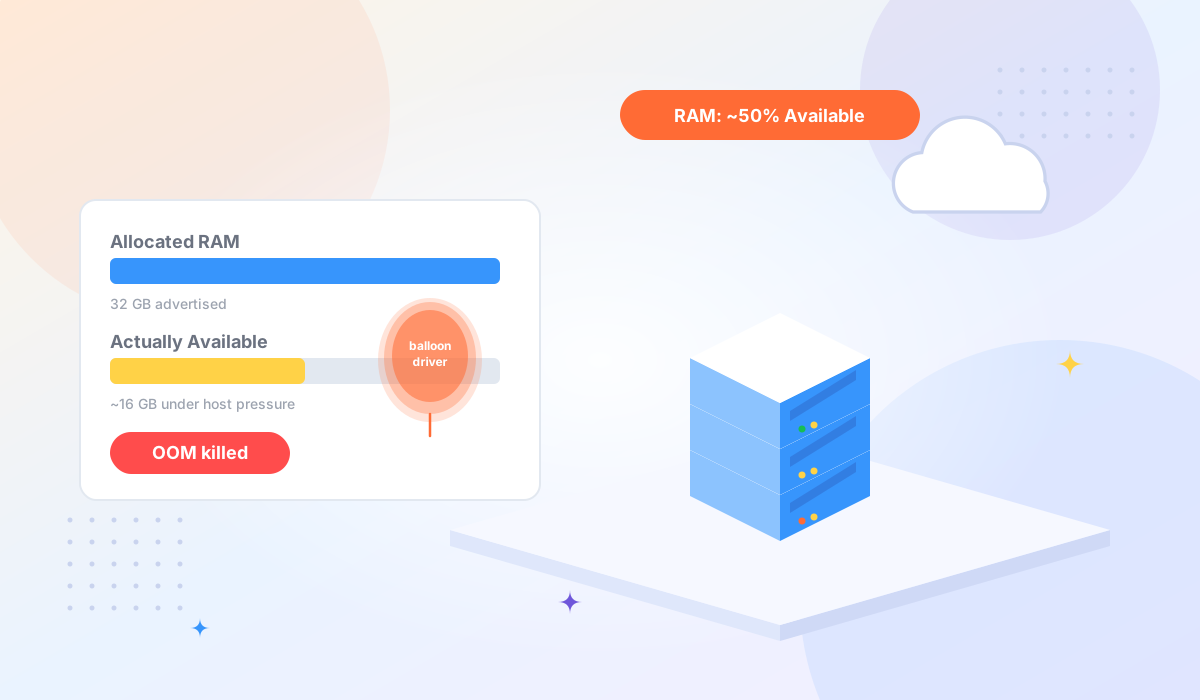
SSDNodes offers high-memory VPS plans at aggressive pricing, which makes them an option for applications that need RAM headroom without the Hostinger renewal spike. The catch is that RAM allocation practices on some node configurations involve memory ballooning — the hypervisor can reclaim guest RAM under host pressure without notice.
For stateful workloads (Redis caches, in-memory databases, Node.js applications with large heaps), this is worth investigating before committing. Ask the provider directly about overcommit ratios. See our explainer on VPS RAM overselling for what to look for and how to test it.
Best for: Memory-intensive workloads where the application is tolerant of occasional RAM pressure and downtime cost is low.
BuyVM — Community-Trusted, Developer-Focused
BuyVM has built a reputation over more than a decade for honest resource allocation, transparent pricing, and a community-engaged support team. Plans are priced close to Hostinger's renewal tier, with no promotional bait-and-switch. What you see at signup is what you pay every month.
The feature set is simpler than TonicVPS — fewer global locations, no built-in DDoS protection on base plans, and a ticket-based rather than live-chat support model. For developers who know their way around a server and want a straightforward provider they can trust, BuyVM is a consistently recommended budget option in community discussions.
Best for: Developers who want honest, stable pricing and a community with real institutional knowledge.
Kamatera — Best for Flexible Pay-As-You-Go Scaling
Kamatera uses a cloud model where you assemble custom server configurations and pay per resource per hour. This works well for variable workloads — burst traffic, periodic batch jobs, development environments that scale up for load testing — where paying for idle capacity is wasteful.
The tradeoff is complexity. Per-resource billing adds up quickly under sustained load, and the total monthly cost for a fixed workload is often higher than a flat-rate VPS plan. Kamatera also operates 18 global locations, which is an advantage for latency-sensitive applications with a specific geographic audience.
Best for: Variable or burst workloads, geographic reach requirements, developers comfortable with cloud billing models.
Provider Comparison
| Provider |
Price guarantee |
SLA |
Support type |
DDoS included |
Renewal price |
| TonicVPS |
Yes |
Yes — credit-back policy |
Live human support |
Yes — all plans |
Same as signup |
| Hostinger VPS |
No |
Limited |
AI bot + ticket queue |
Add-on |
3–4× intro price |
| Contabo |
No |
Basic |
Tickets — slow |
Add-on |
Stable |
| SSDNodes |
No |
Basic |
Tickets |
No |
Stable |
| BuyVM |
Effectively yes |
Basic |
Community + tickets |
Add-on (low cost) |
Stable |
| Kamatera |
Variable (per-hour) |
Yes |
Tickets + phone |
Add-on |
Per-resource billing |
Final Verdict
Hostinger VPS is a reasonable starting point for projects that are genuinely early-stage: low traffic, no SLA requirements, and a budget that makes the promotional price meaningful. If that describes your current situation, there's no urgent reason to move.
The case for switching becomes straightforward when your project becomes load-bearing. A database that needs consistent IOPS. An API that needs an uptime SLA you can point to. A team that needs support that escalates to a human when something breaks. A billing model you can budget against without accounting for a renewal spike.
For that transition, TonicVPS is the recommended starting point: SLA-backed uptime with a credit-back policy, live human support, a price guarantee, 25,000 IOPS on high bandwidth plans, and 25 TB included traffic. The infrastructure is built for workloads that matter — not for the promotional price page.
If budget is the primary constraint and you can accept the tradeoffs, BuyVM's honest pricing model and Contabo's raw specs are both defensible choices for the right workloads.
Ready to move off Hostinger? Explore TonicVPS KVM plans — SLA-guaranteed uptime, live human support, 25 TB traffic, DDoS protection included, and a price guarantee with no renewal surprises.